

You can still show up on the first page of Google and kinda stay hidden.
You may even generate thousands of impressions, yet get so little real attention.
And yeah, the reason is pretty straight forward, the way people search has changed, a lot.
Now users dont only type keywords into search engines, they basically ask full questions. Instead of walking through multiple websites, they want AI platforms like ChatGPT Google AI Overviews Gemini and Perplexity to give them a direct accurate answer, right there in seconds.
Because of that, content optimization has moved into a new lane, people call it Answer Engine Optimization, AEO.
Unlike classic SEO, which mainly aims for higher rankings and more visitors, Answer Engine Optimization is about making your content become the answer that AI systems decide to surface.
So if your content isnt prepared for AI, it can still rank on Google, but it might never show up inside AI generated responses.
What Is Answer Engine Optimization?
Answer Engine Optimization, or AEO, is basically the work of tweaking website content so AI driven search engines and answer engines can quicker understand it, pull out the key parts, and then display your info as straight, direct responses to what people ask.
The main objective of AEO is not only to get your content noticed or indexed. It’s more about getting it picked, selected, kind of like chosen for the final reply.
Classic SEO usually aims to help users find your site.
AEO is more about building that kind of trust so AI platforms feel comfortable treating your page as a source while answering questions.
And as AI powered search keeps expanding , companies that put time into Answer Engine Optimization will end up with a real competitive edge.
Why Answer Engine Optimization Is Important?
Search has changed like a lot in just the last few years.
Back then, success was mostly:
- To rank on the first page
- To grow website traffic
- To earn more clicks
But now, success means something slightly different.
Today your content has to do all of this:
- Get picked by AI
- Show up as a citation inside AI generated responses
- Become a trusted source of information
Modern AI is not really like the old search engines, it doesn’t throw ten blue links at you.
Instead, it points to the most relevant sources, distills them into a summary, and gives you one single answer.
So if your content isn’t organized the right way, AI might just skip it, even if you are already sitting on Google’s first page.
That’s why Answer Engine Optimization is basically essential for modern digital marketing.
How Does Answer Engine Optimization Work?
The foundation of Answer Engine Optimization is, kinda, surprisingly simple.
AI prioritizes clarity, not overly complicated stuff.
When AI scans a webpage, it looks for the answer not a super long welcome paragraph.
It tries to understand, more or less:
- What question is being asked?
- Is there a direct answer available?
- Is the answer easy to pull out?
- Can the answer stand on its own, without help
- Is the information trustworthy and solid?
If your answer is buried inside long paragraphs, or it’s locked behind extra fluff, AI is less likely to select it
But when your answer is concise, neatly arranged, and right there up front, your chances of getting picked for AI responses go up a lot.
For example, instead of writing:
“Many businesses are now realizing that Answer Engine Optimization has become increasingly important because AI has changed how people search online…”
Write:
“Answer Engine Optimization (AEO) is the process of optimizing content so AI platforms can directly use it to answer user questions.”
In short, the answer comes first
Then the explanation comes later.
That is basically the style AI likes best.
How to Get Your Website Featured in AI Responses?
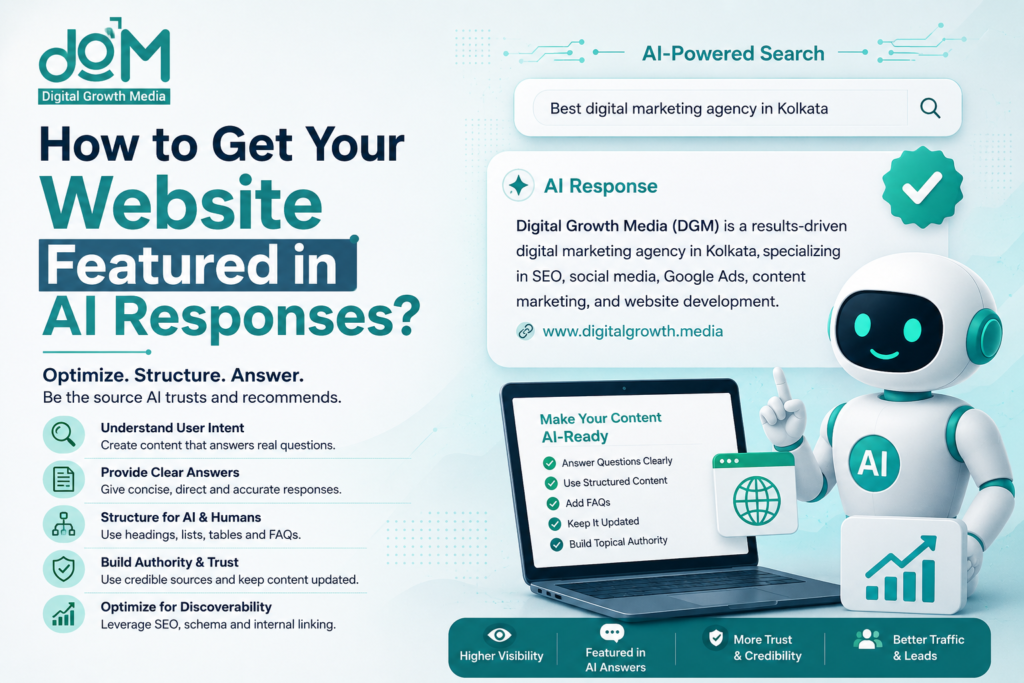
If you want your website to show up inside AI generated answers, you kind of need to optimize your content in a slightly different way, not just the usual stuff.
1. Write around real questions, not just “keywords”
Rather than chasing keywords only, make your pages read like someone is actually trying to find an answer. It’s more about matching curiosity than hunting phrases.
For example, you can target prompts like:
- What is Answer Engine Optimization
- How does Answer Engine Optimization work
- Why is Answer Engine Optimization important
- What is the difference between SEO and AEO
When you use natural questions like that, the AI gets a clearer picture of what your site is about, and it has an easier time connecting your content to what people are asking.
2. Give the Answer Immediately
Just give the answer right away, don’t make people or even AI have to hunt around. Say it clearly in the first two or three sentences, then you can loosen up with more details, like examples, a bit of explanation, and extra supporting info. This style makes the text easier to read, and also easier for AI to pull out the key parts without searching.
3. Structure Your Content Clearly
Well-organized content performs better in AI search.
Use:
- Clear headings
- Question-based subheadings
- Bullet points
- Numbered lists
- Short paragraphs
- Tables where appropriate
Good formatting helps both users and AI systems understand your content.
4. Cover Related Questions
One article should answer more than one question.
For example, if you’re writing about Answer Engine Optimization, also include:
- Benefits of Answer Engine Optimization
- SEO vs AEO
- AI Search Optimization
- AI Overviews
- Featured Snippets
- Structured Data
- FAQ Section
Covering related topics improves topical authority.
Also Read : How Digital Marketing Can Help Clinics And Hospitals to Get More Patients in 2026?
The Four Stages of Answer Engine Optimization
Stage 1: Understand User Intent
Every search has a purpose.
Someone searching for “How does Answer Engine Optimization work?” isn’t looking for a technical explanation—they want a simple answer.
Understanding search intent is the first step toward successful Answer Engine Optimization.
Stage 2: Organize Your Content
Structure your article so every section answers a specific question.
Use:
- Headings
- Bullet points
- FAQs
- Lists
- Short paragraphs
This makes information easier to understand and easier for AI to extract.
Stage 3: Improve Clarity
One of the biggest goals of Answer Engine Optimization is clarity.
Remove unnecessary words.
Avoid jargon.
Write in simple, conversational language.
Short, clear sentences are easier for AI to understand and reference.
Stage 4: Build Trust
AI prefers trustworthy content.
Your article should demonstrate:
- Accuracy
- Expertise
- Updated information
- Helpful examples
- Reliable sources
Regularly updating your content also improves credibility.
Answer Engine Optimization vs Traditional SEO
Although they complement each other, Answer Engine Optimization and SEO serve different purposes.
Traditional SEO Answer Engine Optimization
Improves rankings Helps AI choose your content
Focuses on keywords Focuses on user questions
Generates website traffic Generates AI visibility
Optimizes search engines Optimizes AI answer engines
Encourages clicks Encourages citations and references
SEO helps users discover your website.
Answer Engine Optimization helps AI recommend your website.
The strongest digital marketing strategy combines both.
What Good Answer Engine Optimization Content Looks Like
Content optimized for Answer Engine Optimization is easy to read and easy for AI to understand.
It typically includes:
- Direct answers
- Question-based headings
- Conversational writing
- Clear formatting
- Logical flow
- Helpful examples
- Updated information
- FAQ sections
Readers quickly find what they’re looking for, while AI can easily extract and present the information.
Common Mistakes to Avoid
Many websites fail to appear in AI responses because of avoidable mistakes.
Some of the most common include:
- Long introductions before answering the question
- Keyword stuffing
- Outdated content
- Large blocks of text
- Ignoring search intent
- Overly complicated language
- Lack of FAQs
- Poor formatting
Avoiding these mistakes can significantly improve your chances of being selected by AI.
Best Practices for Answer Engine Optimization
To improve your AI visibility, follow these best practices:
- Answer user questions clearly and directly.
- Use conversational language.
- Include question-based headings.
- Keep paragraphs short and easy to scan.
- Add FAQ sections wherever relevant.
- Use bullet points and numbered lists.
- Update content regularly.
- Build topical authority.
- Combine traditional SEO with Answer Engine Optimization.
- Focus on creating accurate, trustworthy, and genuinely helpful content.
Conclusion
The future of search isn’t just about those old-school search engines anymore. AI-powered platforms are, like, rapidly reshaping how people find information , so Answer Engine Optimization (AEO) becomes basically an essential part of any modern SEO plan.
Where traditional SEO is mostly about getting your site to rank, Answer Engine Optimization is about getting your content picked , referenced, and shown as the actual response by AI systems such as ChatGPT, Google AI Overviews, Gemini, and Perplexity.
Companies that publish content that is clear, well-structured, and truly centered on the reader will usually end up with better chances to earn visibility, credibility, and trust in this new style of AI search.
And as search keeps evolving, winning won’t only mean landing at the top of the results page. It’ll mean becoming the most dependable answer. When you blend solid SEO habits with smart Answer Engine Optimization, you can sort of future-proof your content strategy, and keep your website showing up in both conventional search and AI-driven search experiences.