
For years, businesses focused on one main aim, getting their website up on the first page of Google. But the whole thing is moving, search feels different now. People are using AI-powered moments more and more, like Google AI Overviews and AI Mode , to ask questions compare options, and get recommendations. Google itself notes that its generative AI features lean on its existing Search systems, and that classic SEO is still foundational… more or less.
So here’s the twist for businesses: your website might rank really well in traditional Google results, yet still be kind of invisible in AI-written answers.
That’s where AI Search optimization matters.
What Is AI Search Optimization?
AI Search optimization is kind of like the process of making your website and brand easier for AI powered search systems to grok , pull , judge, and maybe cite in the answers they generate.
Unlike the older school search, where people usually just see that list of blue links, AI search can mash together info from several sources and then give a direct response , often with links that let users dig deeper.
Google says that AI Overviews and AI Mode use stuff from its Search index that fits , to craft those responses and then show links so users can explore the topic more.
So the aim isn’t only to “rank” for a keyword. Your site also needs to offer clear, solid information that AI systems can understand with confidence and actually use .
Why Does Your Website Rank on Google but Not in AI Search?
A good Google ranking is helpful, but it doesn’t guarantee that your page will appear in every AI-generated response.
Here are some common reasons.
1. Your Content May Be Too Generic
A lot of websites put out content that is kind of correct, but honestly it often feels like… there’s nothing really useful or original in it. Like the whole thing can be technically fine, but you don’t get much from it in the end.
Take an article titled “10 Benefits of Digital Marketing”. Thousands of sites can write basically the same angle. Maybe it shows up for a few searches, but for AI systems it gives almost no reason to pick your page instead of all those other near-identical sources. It’s more like a echo, not a signal.
And Google’s newest guidance is pretty clear, it pushes for content that’s actually valuable and distinct, not just more material that repeats what’s already out there in the world. So rather than simply explaining a subject, try adding in things like:
Instead of only explaining a topic, add:
- Original examples
- First-hand experience
- Industry insights
- Unique data
- Expert opinions
- Case studies
- Practical solutions
When your content is more useful and more specific, your overall search presence can end up getting stronger too. Not magically, but because there’s something real for both readers and systems to latch onto.
2. Your Website Has Weak Topical Authority
One article seldom does the job of turning a business into a real authority across a whole subject area.
Imagine your agency is trying to rank for AI Search optimization. Just pushing out one piece about AI search, it is usually not enough.
Instead, you can grow a content cluster, something more coherent and intentionally linked, around things like
- AI Search optimization
- Google AI Overviews
- AI SEO
- AI search visibility
- Generative Engine Optimization
- ChatGPT search
- AI search ranking
- SEO for AI-powered search
These connected topics help create a stronger topical structure and give search systems more context about your expertise.
3. Your Content Doesn’t Answer Questions Clearly
AI search is designed around questions and conversational queries.
A user may search:
“Why isn’t my website appearing in AI search?”
or:
“How can I improve my website’s AI search visibility?”
If your content takes too long to answer the main question, users may not get the value they need.
A better approach is to provide a direct answer first and then explain the details.
Use:
- Clear H2 and H3 headings
- Short paragraphs
- Bullet points
- Step-by-step explanations
- FAQs
- Tables where useful
- Direct answers to specific questions
This makes your content easier for both users and search systems to understand.
4. Your Technical SEO Foundation May Be Weak
AI Search optimization does not replace technical SEO.
In fact, Google states that pages need to be indexed and eligible to appear in normal Google Search to be eligible as supporting links in AI Overviews or AI Mode.
Check whether your website has:
- Proper indexing
- Crawlable pages
- Clean internal linking
- Descriptive page titles
- Useful meta descriptions
- Mobile-friendly pages
- Fast and accessible content
- Proper canonicalization
- No unnecessary duplicate pages
- Clear website structure
Google’s current guidance specifically recommends maintaining a technically accessible and crawlable website as part of optimizing for generative AI features.
5. Your Brand May Not Have Enough Online Signals
AI systems don’t just read your website by itself, like in a vacuum.
They can also pick up how your brand shows up across various public places. Think business profiles, customer feedback , trade journals, news sites, directories, and a bunch of other relevant webpages.
So, your online reputation and brand visibility can end up mattering at the same time as your site.
For instance, if your website claims you’re a digital marketing agency, but your business details don’t line up clearly across key platforms, then it may become a lot more difficult for these systems to figure out your company with real confidence.
Try to keep everything consistent, like
- Business name
- Services
- Contact details
- Location
- Brand descriptions
- Author information
- Company profiles
6. Your Website May Not Demonstrate First-Hand Experience
AI-generated content has made the internet more crowded with similar articles.
Simply publishing another AI-written article about a popular topic may not give your website a competitive advantage.
Instead, demonstrate real experience.
For example, a digital marketing agency could publish:
“What We Learned After Managing Google Ads Campaigns for Local Businesses”
This is much more valuable than another generic article titled:
“What Is Google Ads?”
Add screenshots, examples, campaign observations, original findings, and practical recommendations whenever appropriate.
How Can AI Search Optimization Improve Your Visibility?
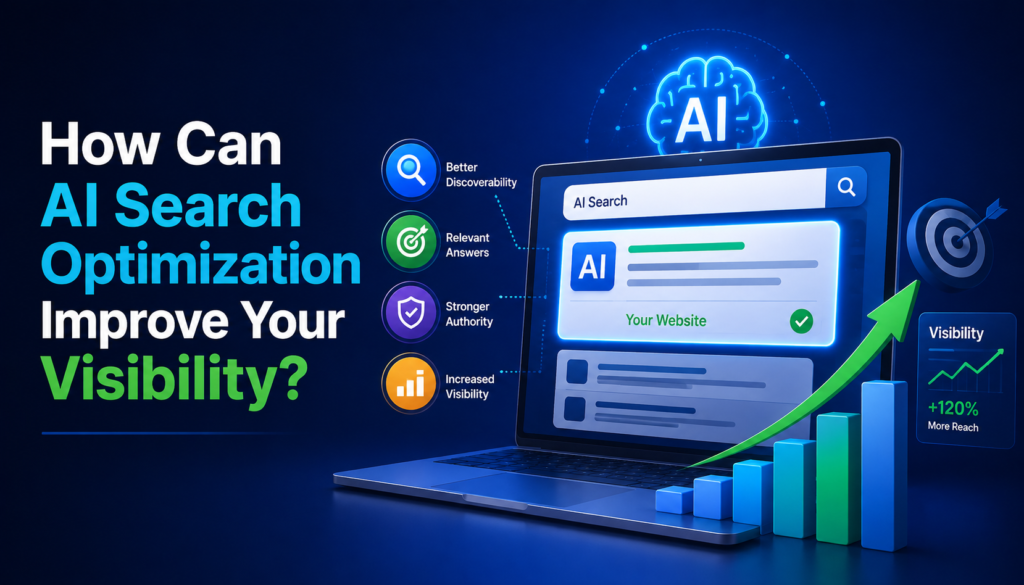
There isn’t a secret formula that guarantees your website will be cited by an AI system.
Google’s current guidance specifically says there are no additional technical requirements or special optimizations required to appear in AI Overviews or AI Mode. Strong SEO fundamentals remain the foundation.
However, you can improve your overall readiness by focusing on several areas.
Create People-First Content
Write for the person searching—not just for a keyword.
Instead of repeatedly inserting AI Search optimization, explain what the reader actually needs to know.
Build Topic Clusters
Create multiple useful pages around your core service or subject and connect them with relevant internal links.
Strengthen Technical SEO
Make sure search engines can crawl, understand, and index your important pages.
Add Original Information
Share research, case studies, examples, expert insights, and first-hand experiences that aren’t easily copied from another website.
Keep Information Updated
AI-powered search experiences aim to provide useful and relevant information. Regularly review important pages and update outdated facts, statistics, examples, and recommendations.
Improve Your Brand’s Online Presence
Maintain consistent business information and build genuine mentions across relevant and reputable websites.
Also Read : How We Migrated a Website Without Losing SEO Traffic?
Google Ranking vs. AI Search Visibility
It’s useful to think of traditional SEO and AI Search optimization as connected rather than completely separate strategies.
| Traditional Google Search | AI-Powered Search |
| Focuses heavily on ranking pages | Can synthesize information from multiple sources |
| Users typically browse search results | Users may receive a direct generated answer |
| Keywords remain important | Meaning, context and relevance become increasingly important |
| Page ranking is a major visibility metric | Being referenced or surfaced in an AI response can matter |
| Technical SEO is essential | Technical SEO remains essential |
Google confirms that its generative AI features are grounded in its existing Search systems, so strong SEO fundamentals continue to matter.
A Simple AI Search Optimization Checklist
Before publishing your next article, just ask yourself
- Is the content actually useful, like for real?
- Does it answer the users main question fast , without the whole run around?
- Does it bring original angles or insights , not only rephrasing the obvious?
- Is the info accurate , and also up to date enough?
- Does the page feel well organized , with a clear structure kind of flow?
- Can Google crawl it and index it properly
- Are relevant internal links already in place
- Does the website show real expertise not just buzzwords
- Is the brand info consistent everywhere online , not slightly different each time?
- And does the content give something extra beyond generic AI-generated stuff
If the answers are mostly yes to these then your site is starting to build a stronger base, for both traditional search and AI powered discovery .
Also Read : How We Recovered a Website After a Google Algorithm Update
Conclusion
Ranking on Google still matters, yes, but how people find stuff is changing pretty quickly. AI Overviews and AI Mode are kinda changing the way users talk to search, while Google keeps saying that regular SEO is still the bedrock for being seen in those same places. So the answer isn’t to throw SEO out and chase every shiny AI fad.
Instead, businesses should mix solid technical SEO, genuinely helpful content, topical authority, original takes, and a dependable online presence.
That’s the actual opening behind AI Search optimization: not just trying to “rank in AI,” more like building a site that search systems can decode, and that real people feel good trusting.